This NBA season has been full of surprises to say the least. From the historic campaigns of the Oklahoma City Thunder and Cleveland Cavaliers, to Luka Dončić being traded, to the Phoenix Suns’ disastrous year — this regular season may go down as one of the most intriguing from a headline perspective. Yet hidden in plain sight has been my favorite story of the year: the Detroit Pistons’ ascension into a legitimate playoff threat.
The Pistons became the first team in NBA history to triple their win total, jumping from 14 to 44 wins — a remarkable 30-win improvement. Which other teams in recent NBA history have pulled off a similar turnaround?
- 07′-08′ Celtics: 42 win improvement after creating the first “Big Three” adding Ray Allen and Kevin Garnett. (from 24–58 to 66–16)
- 97′-98′ Spurs: 36 win improvement after drafting Tim Duncan with the first overall pick and David Robinson coming back from injuries (from 20–62 to 56–26)
- 04′-05′ Suns: 33 win improvement adding Steve Nash who won MVP (from 29–53 to 62–20)
One common thread among historic NBA turnarounds is the addition of Hall-of-Fame-level talent. While a few Pistons players have certainly taken major leaps this season, Detroit didn’t land a marquee name; instead, they added complementary role players on the margins. Despite that, the transformation has been remarkable. As I’ll explore in more detail, the Pistons made several strategic adjustments, and the results are clear: statistical improvements across the board. In nearly every key metric, the team has elevated its play — going from a bottom-five team on both ends of the floor to a squad that ranks in the top half of the league in both offensive and defensive efficiency, as shown below.

Spacing
The Pistons made several key offseason acquisitions, including Tobias Harris, Malik Beasley, and Tim Hardaway Jr. — all of whom provided a much-needed boost in perimeter shooting. Malik Beasley, in particular, deserves serious consideration for Sixth Man of the Year, finishing second in the league in total made threes (by 1 3-pointer!). This influx of shooting dramatically improved Detroit’s offensive spacing, which had been lacking since the departure of Bojan Bogdanović last season.
Without a reliable perimeter threat, Detroit struggled to generate consistent offense. The additions of Harris, Beasley, and Hardaway Jr. had two key effects:1) the Pistons shot more threes and did so more efficiently, and 2) it freed up Cade Cunningham to play more to his strengths, exploiting open lanes and operating with greater control in the half-court.
Cade Cunningham – a Budding Superstar
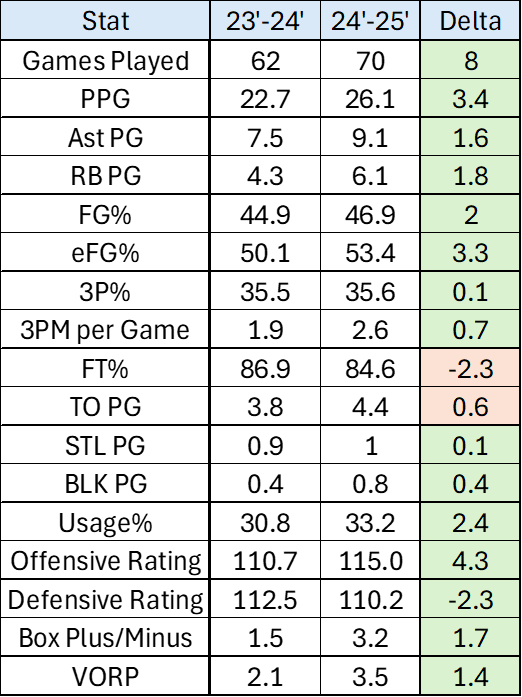
Another key factor in the Pistons’ resurgence has been the rise in Cade Cunningham’s game from last season to this one, as he’s poised to earn All-NBA honors. Cade has improved his offensive efficiency while increasing his overall scoring output, becoming a true three-level threat. As a playmaker, he’s taken another leap, ranking fourth in the league in assists and second in assist percentage (averaging nearly nine assists per game). Ultimately, Cade is the centerpiece of Detroit’s offense and a foundational piece for sustained success. On the defensive end, his size and IQ allow him to be a versatile, switchable defender, further bolstering the Pistons’ evolving defensive identity.
Note: There’s a sizable contingent—one I agree with on the margin—that argues Cade hasn’t necessarily made a “dramatic improvement” this season, but rather that his supporting cast is no longer as poor as it was the year before.
Return of the ‘Bad Boys’
One of the most noticeable shifts in the Pistons’ identity this season has been their commitment to defensive intensity and physicality — a style reminiscent of the franchise’s iconic “Bad Boys” teams of the late ’80s and early ’90s. Detroit has fully embraced a gritty, no-nonsense defensive philosophy that reflects the city’s blue-collar spirit.
The numbers support this identity shift. The Pistons ranked 4th in team fouls, 1st in technical fouls, and were among the league leaders in ejections — not just as a sign of undisciplined play, but as evidence of a team that refuses to back down. Players like Jalen Duren, Isaiah Stewart, and Ausar Thompson bring toughness on a nightly basis, often acting as tone-setters early in games. Even Cade Cunningham, typically known for his calm and cerebral style, has emerged as a more vocal and physical leader. The result is a team that, while still developing, has begun to embody the same edge that defined the original “Bad Boys”; a culture that resonates deeply with the Detroit faithful.
Among those driving this new identity is Jalen Duren, who has taken a leap as a defensive anchor and consistent double-double machine. Ranked 11th in the league in Defensive LEBRON, Duren’s interior presence and rim protection have been vital to the Pistons’ success. At just 21 years old, his continued development will be critical to the team’s long-term trajectory.

In addition to Duren, Ausar Thompson has been a defensive cornerstone for the Detroit Pistons. His elite athleticism, lateral quickness, and ability to guard multiple positions have brought much-needed versatility and energy to the defensive end. Whether switching onto guards or contesting shots at the rim, Ausar has consistently disrupted opposing offenses and helped anchor the team’s physical identity.
J. B. Bickerstaff Coaching Transition
After signing Monty Williams to a record-breaking deal for an NBA head coach, the Pistons parted ways with him following a disappointing 2023–24 season. Ownership expressed concerns about Williams’ decision-making, particularly his player rotations and the limited role given to Jaden Ivey, which many viewed as detrimental to the team’s development. Some even speculated that Williams was trying to get fired — citing his persistent use of Isaiah Livers (to the point that the team traded him just to remove him from the rotation) and Killian Hayes (who was eventually waived).
J.B. Bickerstaff arrived and immediately rejuvenated Detroit’s young core. His player-first approach elevated performance across the roster, giving players the confidence to thrive. Defensively, Bickerstaff has emphasized collapsing the paint and forcing opponents to the perimeter — a strategy that’s paid off, as the Pistons now rank fifth in the league in opponent points in the paint. Overall, Bickerstaff has established a winning culture in Detroit and can potentially propel the Pistons into legitimate Eastern Conference contention in the years ahead.
 Perspectives on the NBA