For the past few years, it has been widely speculated that the NBA will add two new expansion teams—most likely in Las Vegas and Seattle—bringing the total number of franchises from 30 to 32. These potential additions have generated considerable buzz among those who closely follow the league. It’s been over two decades since the NBA last expanded, when the Charlotte Bobcats joined in 2004.
From a business perspective, NBA team valuations are at an all-time high. The Boston Celtics recently sold for $6 billion—despite not owning their own stadium—potentially setting a new benchmark for what expansion teams might cost. For many billionaires, seeing peers own franchises in the NBA or NFL may spark the thought, “Well, that looks like a lot of fun.” Then, viewing it through the lens of an investor, they likely see compelling advantages: 1) Enormous demand and limited supply (only 30 teams, rarely sold), 2) rising media, streaming, and TV deals, and 3) growing global popularity of the NBA.
To emphasize the growth in media rights: the league’s previous TV deal, signed in 2014, was worth approximately $24 billion over nine years (~$2.7 billion annually). The new deal, set to begin in the 2025–26 season, is worth a staggering $77 billion over 11 years—or about $6.9 billion annually. That represents an impressive 9% annual growth rate.
Given all that, buying an NBA team might sound like a dream. You land a franchise in a booming market like Las Vegas, draft a few superstars, and live happily ever after. But history suggests otherwise. NBA expansion teams have typically struggled out of the gate. In fact, of the last seven expansion teams, only four playoff appearances were made in their first five seasons combined. Even five years in, most expansion teams are still finding their footing.

Why does this happen and what are the prospects for a new expansion team?
The main difficulty for expansion teams are the rules set in place by the NBA for how these teams are built. Here is a link of the full rules from NBA.com from the last expansion draft (https://www.nba.com/hornets/news/draft_central_expansion_rules_summary.html) but below is a rough approximation:
- Expansion teams are allowed to pick “unprotected” one player from each NBA team
- Each NBA team is allowed to protect up to 8 players on contract or will be restricted free agents
- The team is given a draft pick – historically from 4-11. Note they aren’t apart of the lottery, the pick is set.
From above, you may see how a new expansion team would be in the “tanking” bucket of teams to start and likely have the worst NBA roster. Since the team knows they don’t have the potential to build a playoff caliber roster, they would opt for a young roster to maximize their lottery odds in following seasons.
Potential Roster
As a thought exercise, I simulated what a potential roster might look like in the event of an NBA expansion. I assumed that each existing team would be allowed to protect seven players, as opposed to the traditional eight—based on those under contract for next season, including restricted free agents. Unrestricted free agents were excluded from consideration. The expansion team was required to select a minimum of 14 players, although many of those players could be traded or waived before the start of the season. As a result, the total number of selected players exceeds the typical 15-man roster, with some picks strategically used to acquire future draft capital via trade.
Below is a hypothetical roster based on this framework, assuming only one expansion team is added next season. While there will undoubtedly be debate over which players would actually be protected or exposed by each team, I believe these decisions would only impact the margins of the roster and would not meaningfully change its overall quality.
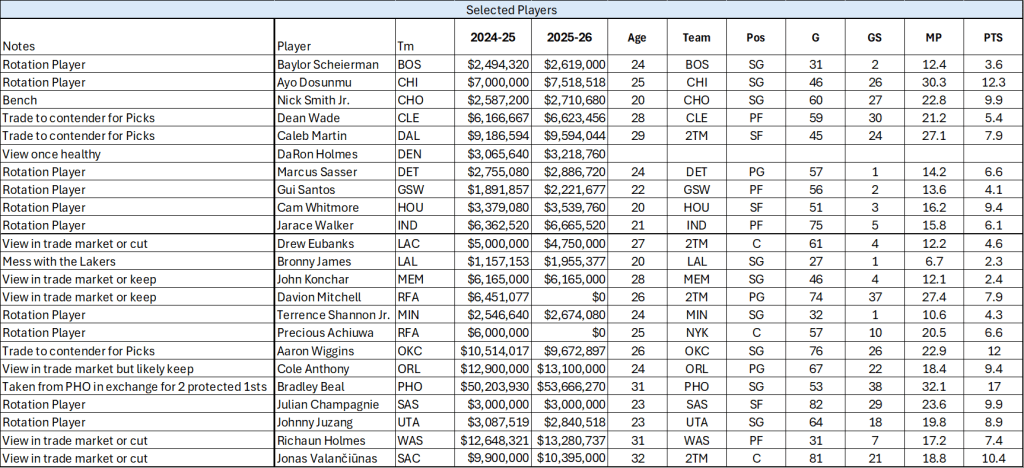
A significant portion of the players selected above were chosen with the intention of extracting future draft compensation. For instance, several playoff contenders would likely be interested in acquiring players such as Aaron Wiggins, Caleb Martin, Dean Wade, and Davion Mitchell. In scenarios where a team wishes to protect an additional player beyond the allowed seven, they could offer draft capital as an incentive to the expansion team to pass on selecting that player. For example, the Thunder—given their abundance of first-round picks—might be inclined to include one to ensure they retain Aaron Wiggins.
Another interesting case involves the Phoenix Suns, who may be willing to part with one or two of the protected first-round picks they received at last year’s trade deadline in exchange for shedding Bradley Beal’s contract. While the NBA might ultimately implement rules around protecting players with no-trade clauses, I’ve chosen not to apply such restrictions here, purely for the sake of this exercise.
Below is what the 15-man roster could look like:
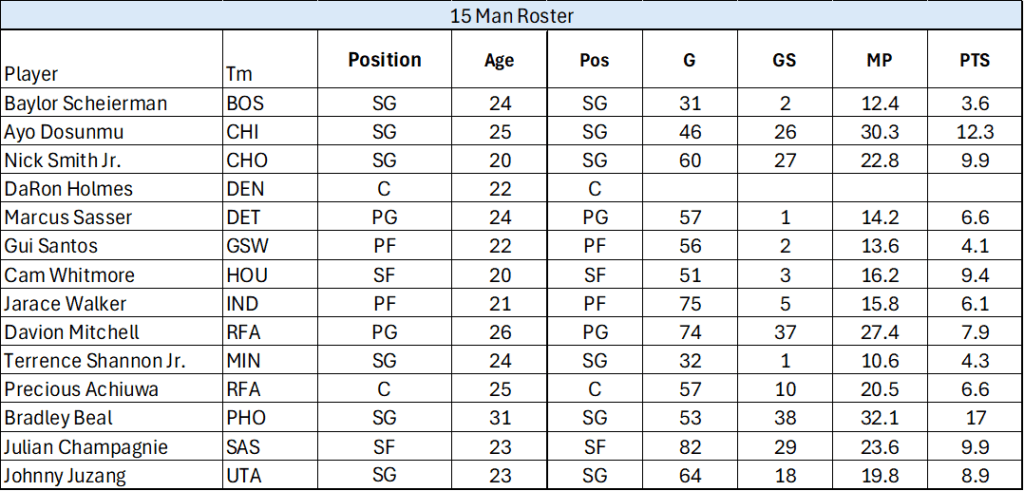
Taking this 1-step forward, lets assume our fake expansion team gets 4th pick in the 2025 draft and they take Ace Bailey from Rutgers. Here is what I would project their starting line-up to be.
- 1: Davion Mitchell – Ball Handling Guard (if not traded)
- 2: Julian Champagnie – Wing
- 3: Cam Whitmore – Wing
- 4: Ace Bailey – Wing
- 5: Precious Achiuwa – Center
The projected starting five would likely rank as the weakest among all 30 NBA teams. This rebuild would begin at the nadir of the team’s potential, focused entirely on long-term development and forward-looking growth.
What can the NBA do to make this more competitive?
While the prospects of owning an NBA team is exciting, being put in an incredibly disadvantaged position may not be as thrilling for a potential buyer of the expansion team. What are some potential changes that can be made?
- Lower Protected Players to 5-6: Reducing the number of protected players from 7–8 to 5–6 would significantly improve the quality of available talent. While this may seem like a marginal change, it would allow the expansion team to acquire players with legitimate starting or rotation-level potential.
- Allow teams to pick more then 1 player from each team: Although potentially unfair to top-tier teams, permitting the expansion team to select more than one player per existing franchise would greatly improve roster construction. This would be especially impactful with teams like Oklahoma City or Houston, whose benches are filled with young, high-upside talent. To offset the imbalance, the league could award affected teams end-of-round draft picks (e.g., after the 1st round) as compensation.
- Give teams more salary room in 1st few years: Granting salary cap relief—such as temporary exemption from apron or luxury tax restrictions—would enable the expansion team to be more competitive in free agency. This could accelerate the rebuild and help attract veteran talent without immediate cap pressure.
- Extra Draft Compensation: Guaranteeing top-3 picks for a fixed number of years would ensure the expansion team has access to franchise-altering talent. This structure also disincentivizes tanking, allowing the front office to prioritize development and winning over draft odds.
Overall, several of the ideas above could be realistically implemented—especially considering the bleak historical performance of NBA expansion teams. However, it would be a tough sell to current owners if the proposed rules significantly disrupted their own roster construction. Regardless, the game theory and roster-building dynamics of an expansion team will be truly fascinating to watch once the NBA formally announces its plans to expand.
Sources: NBA.com, basketball-reference.com
 Perspectives on the NBA